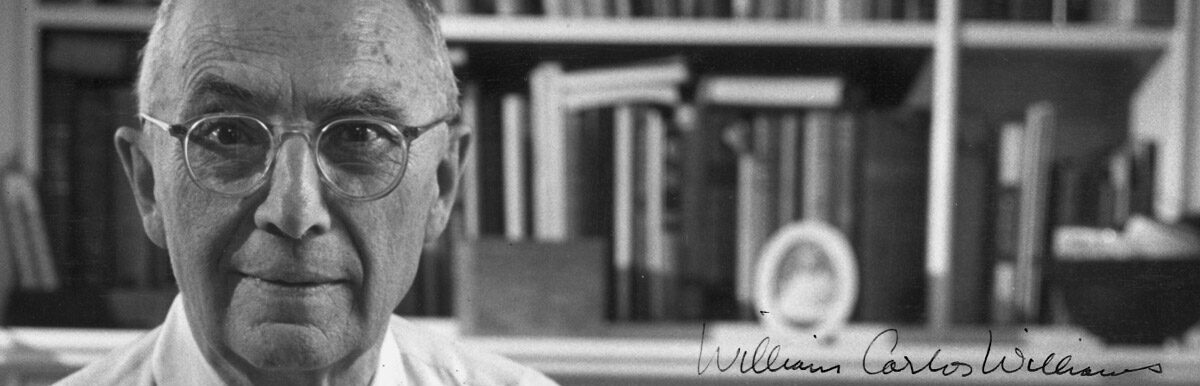

Readers of Williams will appreciate a recent poem by the poet, essayist, translator, editor, and attorney, Martín Espada, whose works include A Mayan Astronomer in Hell’s Kitchen (2000), Alabanza: New and Selected Poems, 1982–2002 (2003), The Republic of Poetry (2006), The Trouble Ball (2011), The Meaning of the Shovel (2014), Vivas to Those Who Have Failed (2016), Floaters (2021), and Jailbreak of Sparrows (2025). He is the translator of the Puerto Rican poet Clemente Soto Vélez, and editor of an anthology of Latino and Latina poets El Coro (1997) and Poetry Like Bread: Poets of the Political Imagination (Curbstone, Expanded Edition 1994).
The poem “Insult” is dedicated to William Carlos Williams. A print version of the poem Insult appears in the Michigan Quarterly Review 64.1 (Winter 2025); and a link to the poet reading the poem is available at the MQR Sound podcast.
Following the dedication to William Carlos Williams, “For William Carlos Williams (1883–1963),” the poem begins:
Stroke: insult to the brain, leaking blood; insult to the right eye, now blind; insult to the right hand, now dead; insult of the X-rays, lighting up the skull like a bulb; insult of doctors telling him what he already knew, the poet-doctor who brought three thousand infants to light by the river and the silk mills of Paterson; insult of the black bag open and empty after the last house call; insult of the bills clogging up the mailbox, sliding off the kitchen table.
Espada explains in a Facebook post (February 3 2025) that “Insult” is “about William Carlos Williams and the drive to survive, even transcend the ‘insults’ of our lives to carry out our work and make our voices heard.” In the second stanza, Espada refers to details in Williams’s FBI file:
The report of Loyalty Data in his FBI file had its own beats, words like the stutter of tommy guns in the G-man movies of Hoover’s imagination: Chairman of the Local Committee for Medical Help to Loyalist Spain, State Committee of the New Jersey Civil Liberties Union, American Committee for Protection of Foreign Born, Free Speech Rally Wednesday at Carnegie Hall for the Hollywood Ten, New Masses, Partisan Review.
In 1952, Espada reminds his readers, following a stroke, Williams “retired and spent two months hospitalized for depression. His appointment as Consultant to the Library of Congress—today’s Poet Laureate—was revoked after an FBI investigation into false charges that he was a communist.”
In his October 9, 1952 letter to James E. Hatcher (Chief of Investigations in the U.S. Civil Service Commission), J. Edgar Hoover asks, “Can’t the Library of Congress find a distinguished poet with a pro-freedom record to fill the post? As long as the U. S. Govt. is subsidizing people, why doesn’t it subsidize anti-totalitarians?” The FBI file compiled on Williams, that includes the results of an investigation, with excerpts from Williams’s poems and prose, will be a document of interest to readers today and in the years ahead.
To purchase a copy (hard copy or pdf) of the Winter 2025 issue go to the MQR Issue Order Form at the Michigan Quarterly Review.
(Photo credit: Wikimedia Commons)
