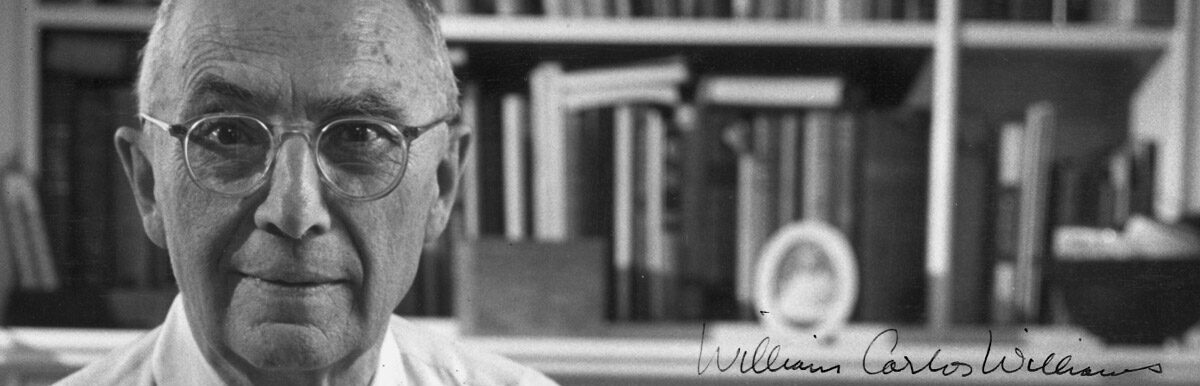
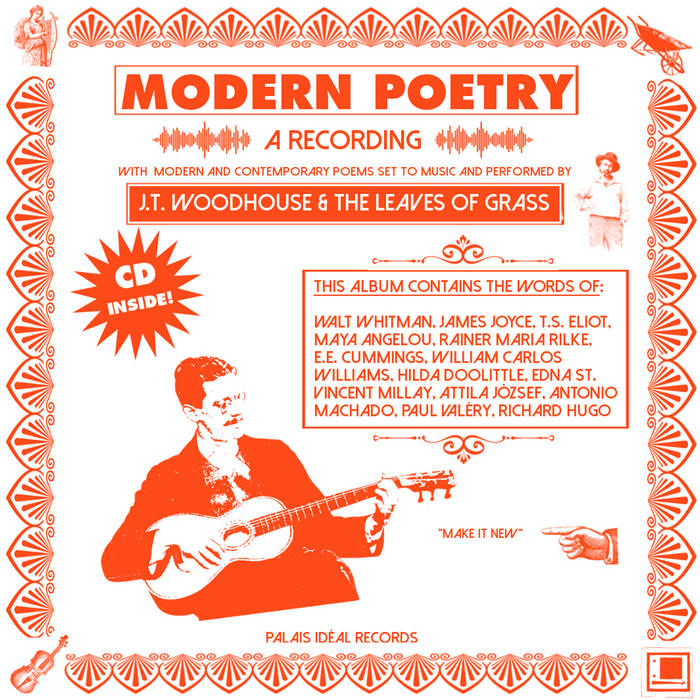
Modern Poetry, an album of modern and contemporary poems—by Walt Whitman, Maya Angelou, Rainer Maria Rilke, James Joyce, T.S. Eliot, William Carlos Williams and more—set to music in the folk tradition and performed by J.T. Woodhouse & The Leaves of Grass, a band of musicians from Northern California.
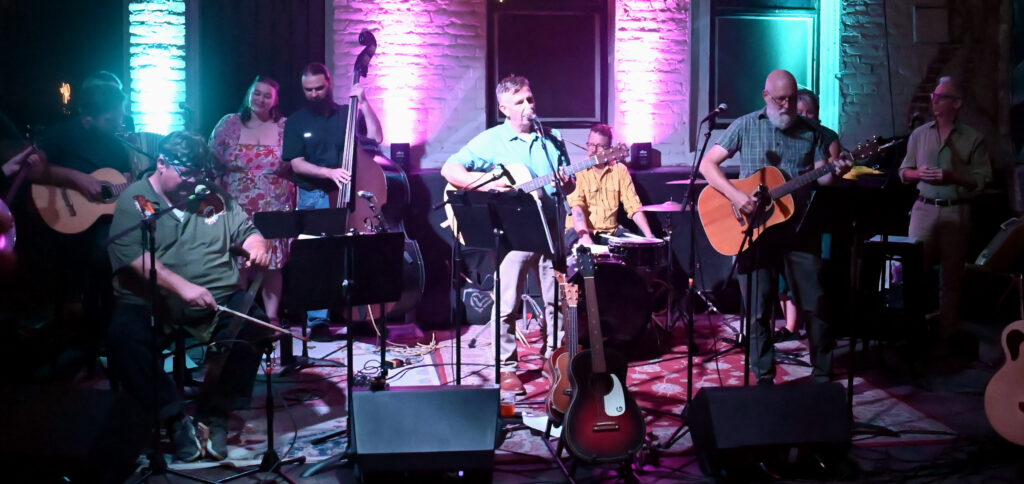
The album features “poem-songs” by Walt Whitman, William Carlos Williams (“The Red Wheelbarrow”), H.D., E.E. Cummings, T. S. Eliot, Maya Angelou, Richard Hugo, and Antonio Machado, among others.
For a preview click here or go to Facebook (featuring “The Red Wheelbarrow”).
Purchase Modern Poetry at jtwoodhouse.bandcamp.com
Stream on Spotify and Apple Music
Below is a foreword (from the liner notes) by Jason Cassidy (aka J.T. Woodhouse)
_______________________________________________________________________
This project started with one lonely voice:
I have no father and no mother / I have no God, I have no land / neither cradle, nor a cover / nor kiss, nor lover’s hand
That opening stanza from “Tiszta szívvel” (“With all my Heart”) a 1925 poem by Hungarian writer Attila József (translated by Peter Hargitai) crawled under my skin as I sat against the back wall of a cramped English classroom at Chico State University. It was the late-’90s, the course was Modern Poetry, and after the poem was read, I turned to my buddy and fellow musician Donald Beaman and said something along the lines of, “That sounds like the opening to the best country song ever.”
That same week, I got to work trying to write it, eventually coming up with a slow waltz that utilized the entire poem and repurposed my favorite line for a chorus that I imagined would make József the envy of Music Row: “I’ll break in / with all my heart / and if need be I’ll kill.”
József’s poem and that class sent me down a path where the Rilkes, Cummings and Whitmans would join the Cohens, Prines and Dylans as guides on my journey in music, and just as I have tried my hand at many of my favorite songs, occasionally I’ve been inspired to sing a favorite poem. That habit led to a few more “poem-songs” composed over the years, then a lot more during the COVID pandemic, and eventually to collaborating with 16 friends and recording this 15-song Modern Poetry album featuring the words of 13 modern and contemporary poets set to music.
I chose folk music as the general style for this project because of its egalitarian heart. The basic composition of these tunes is simple; they’re easy to play and share with others. Also, the themes running through the poems are reminiscent of the sad, beautiful, universal songs of the folk canon. The words put to music here sing about class, community, and regular people making something of this life while powerful forces work against them; they sing about seeking humanity amid industrialization and in the aftermath of war; they sing about mortality and celebrate the seizing of each day.
And, interestingly (to me at least!), many of the poems featured on this album were published during the 1920s and 1930s, the same time period as the release dates of songs featured on the seminal folk music compilation, Harry Smith’s Anthology of American Folk Music (Folkways, 1952). That revelation inspired me to mimic the style of Smith’s liner notes for the booklet accompanying this Modern Poetry album.
One way to view this project is as an exercise of borrowing these modern poems from the page and returning them to the oral tradition. And now that they’ve been added to folk’s extended catalogue, maybe they’ll get passed around folk circles? Or, looking at it from the folk music side of things, perhaps these new words provide a relative refresh for a tradition built largely on a collection really old stories, an update inspired by modern poetry’s guiding principle to “Make it new.” Truth is, the mission here is mostly personal. When I got to Whitman, I tapped into the multitudes, and I found that a gratifying use of that energy source was in sharing the words through song. And my friends have been down to join me! So, here I am, i celebrate … i sing … for every atom belonging to me as good belongs to you.
