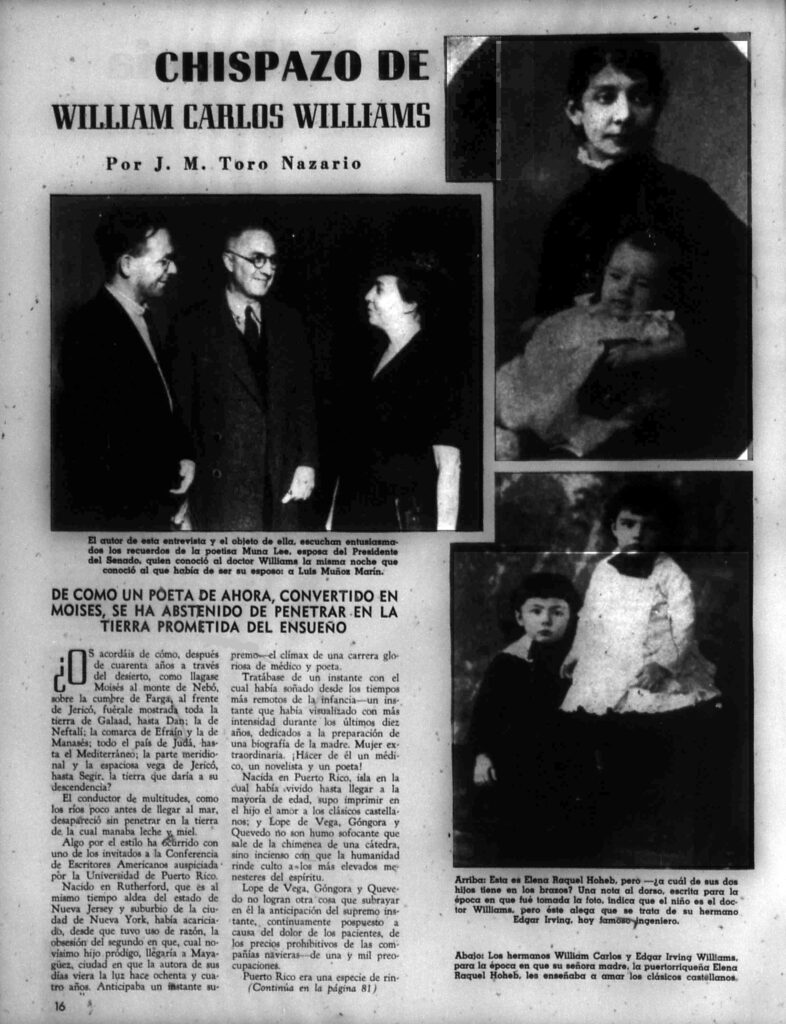
First page of a feature article about WCW that appeared in a Puerto Rican magazine following his first visit to the island in 1941
***
Acosta-Ponce, Carlos D. “The Role of the Environment and Nature, and their Decay in the Face of Industrialization in William Carlos Williams’ Paterson.” Atenea XXXIII (enero-diciembre 2013): 71-90.
Aponte Alisna, Marta. La muerte feliz de William Carlos Williams. Sopa de Letras, 2015.
Cohen, Jonathan. Empty Hills—Deep Woods—Green Moss: William Carlos Williams’s Chinese Experiment. Words Without Borders (2018).
_____. Reading the Williams(-Amaral) Translations of Latin American Poetry: How to Appreciate the ‘Carlos’ Personae of the Late Years. William Carlos Williams Review 33.1-2 (2016): 37-41.
_____. Recovering a Masterpiece of Social Prose: William Carlos Williams’s Lost Translation of ‘Cage.’ Translation Review 110.1 (2021): 4-14.
_____. William Carlos Williams’s The Dog and the Fever: Baroque Proto-Modernism as American Modernist Innovation. William Carlos Williams Review 39.2 (2022): 135-59.
Feinsod, Harris. “Hemispheric Solidarities: Wartime Poetry and the Limits of the Good Neighbor.” The Poetry of the Americas: From Good Neighbors to Countercultures. Oxford UP, 2017. 28–92.
Herlihy-Mera, Jeffrey . Latinx Multilingualism and “American” Modernism: Concealed Transcultural Depths in William Carlos Williams’s English. Voces del Caribe: Revista de Estudios Caribeños. 11.1 (Fall/Otoño 2019). 1059-1095.
Liste Noya, Jose. “The Death of the Modernists: The Case of William Carlos Williams.” Interpretations of English: Essays on Literature, Culture and Film 1998: 71-83.
López, Jotacé, An Interview of Marta Aponte Alsina by Juan Carlos López Latin American Literature Today 2 (April 2017).
Marzán, Julio. The Spanish American Roots of William Carlos Williams. U of Texas P, 1994.
Mota, Miguel. “’It Looked Perfect to My Purpose….’: William Carlos Williams’s Contact with Spanish Author(s). Journal of Modern Literature. 18.4 (Autumn 1993): 447-459.
Park, Stephen M. “Mesoamerican modernism: William Carlos Williams and the archaeological imagination.” Journal of Modern Literature. 34.4 (Summer 2011).
Ramos, Peter. “Cultural Identity, Translation, and William Carlos Williams. Special issue on Puerto Rican, Latina/o, Chicana/o, and Caribbean American Literature. Multi-Ethnic Literature of the United States (MELUS) 38.2 (Summer 2013).
_____. Poetic Encounters in the Americas: Remarkable Bridge. Routledge: 2020.
Rendón, Armando. William Carlos Williams–Latino Poet. Somos en Escrito. September 16 (First published February 1, 2010, as the inaugural feature of Somos en escrito Magazine).
Rodriguez Garcia, Jose Maria. Intertextual and Inter-Ethnic Relations in William Carlos Williams’s ‘To Elsie’: Points of Contact. Journal X: A Journal in Culture and Criticism Vol. 7 : No. 1 , Article 2 (2002).
_____. “Ruination and Translation in William Carlos Williams.” Genre. XXXII (Fall 1999): 225-244.
_____ . “War and Degradation in Edgar Lee Masters and William Carlos Williams.” Orbis Litterarum 58 (2003): 79-100.
Sánchez González, Lisa. Modernism and Boricua Literature: A Reconsideration of Arturo Schomburg and William Carlos Williams. American Literary History 13.2 (Summer, 2001): 242–264
Williams in Puerto Rico
William Carlos Williams, An Informal Discussion of Poetic Form. The First Inter–American Writers’ Conference, University of Puerto Rico (April 14–23 1941).
William Carlos Williams Reads “Asphodel I” at the University of Puerto Rico in April 1956. The complete recording (14:07) is available on the Penn Sound William Carlos Williams page and the direct link is this MP3 file
Selected Translations by William Carlos Williams
Rechani Agrait, Luis. From My Excellency. Translated from the Spanish by William Carlos Williams. “Spanish-American Number” [poetry] from the Spanish of various authors (Others, 1916)
“The Man Who Resembled a Horse” [fiction] from the Spanish of Rafael Arévalo Martínez (The Little Review, 1918)
Last Nights of Paris [fiction] from the French of Philippe Soupault (1929)
“Cage” [fiction] from the French of E. C. Fabre (Blast, 1933)
The Dog and the Fever [fiction] from the Spanish of Don Francisco de Quevedo (1954; repub. & attrib. to Pedro Espinosa, 2018)
“The Cassia Tree” [poetry] from the Chinese of various authors (New Directions 19, 1966)
By Word of Mouth [poetry} from the Spanish of various authors (2011). Ed. Jonathan Cohen.
